
Present tense- Regular verbs
In this video, I will be explaining the present tense starting from the basics, and its endings.
First, I cover the fundamental rules of Spanish, how verbs function, and the Spanish personal pronouns.
Next, we go over how to conjugate verbs in the present tense, practice with exercises, and finish by learning how to form common phrases in Spanish you’ll use in daily life.
Primero vamos a revisar conceptos básicos
First, we are going to revise basic concepts
1- Hay tres tipos de verbos en español, y todos terminan o en «-ar», «-er» o «-ir»
There are three types of verbs in Spanish, and they all end in -ar, -er, or -ir.
2- Diferentes personas de las que hablar. En mi vídeo tienes la explicación completa.
Different people to talk about. In my video you have the full explanation.
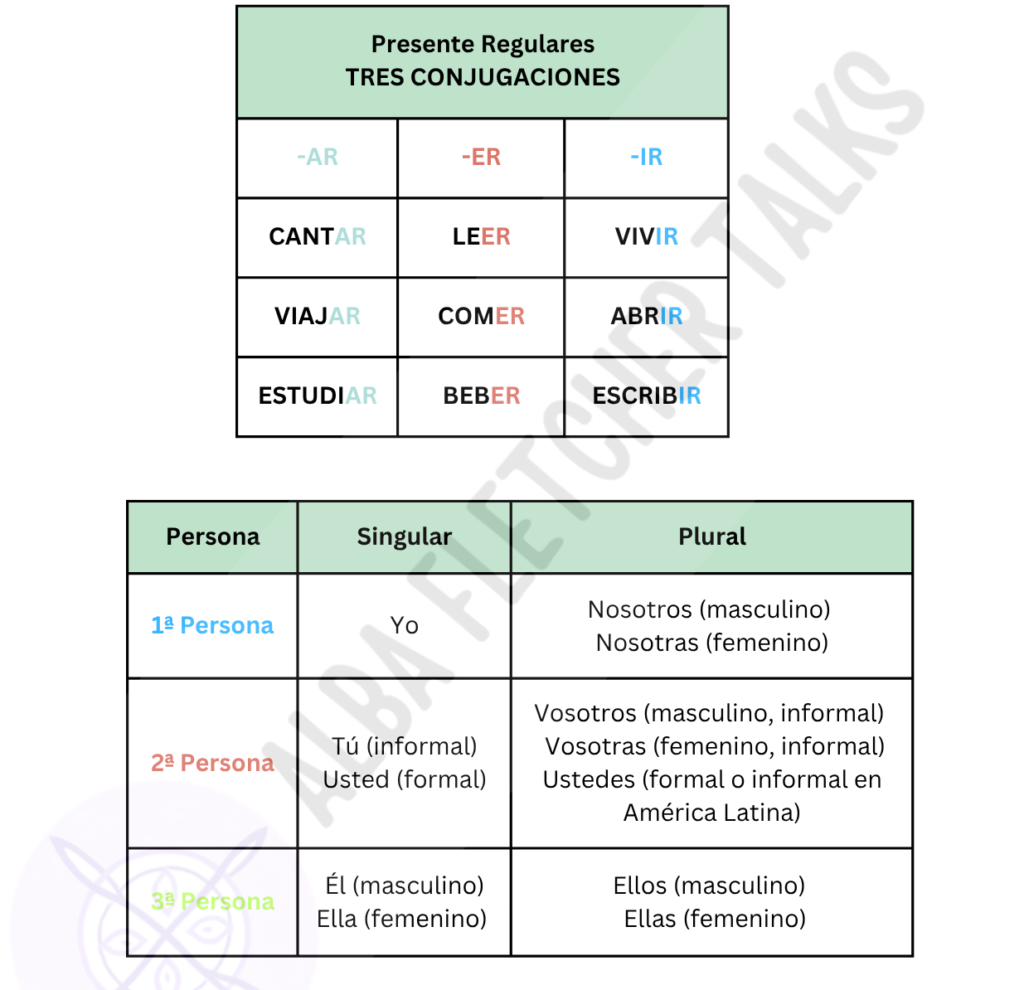
Explicación presente de indicativo
Ahora aprendamos a conjugar los verbos regulares en español.
En el vídeo tienes la explicación
Now let’s learn to conjugate the regular verbs in Spanish.
In the video you have the explanation.
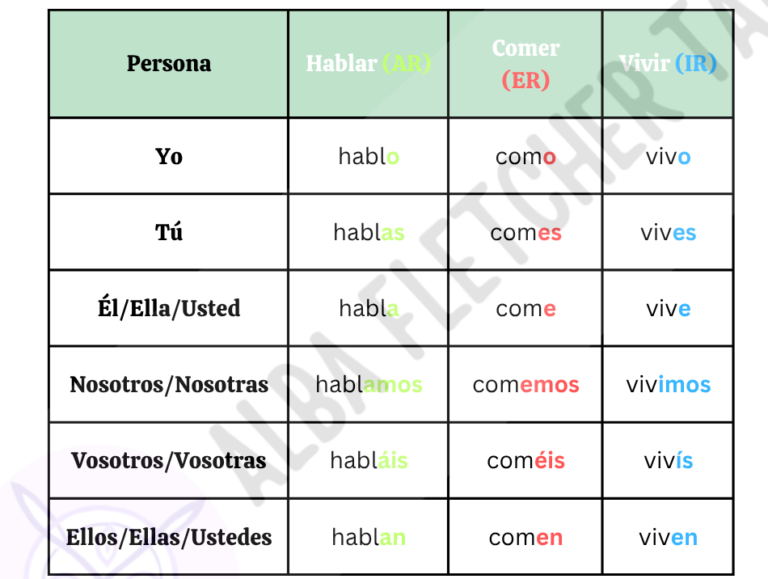
NO MEMORICES LOS VERBOS SIN MÁS. NECESITAS MEMORIZAR, PERO UTILIZÁNDOLOS EN FRASES
DON’T JUST MEMORIZE VERBS IN ISOLATION. YOU NEED TO MEMORIZE THEM, BUT BY USING THEM IN SENTENCES.
Ejercicio presente verbos regulares
Exercises of Spanish present regular verbs
Vamos a practicar los verbos regulares completando las frases.
INTENTA TRADUCIR cada frase antes de completar para aprender al mismo tiempo vocabulario y estructura
Let’s practice regular verbs by completing the sentences. TRY TO TRANSLATE each sentence before completing it to learn vocabulary and structure at the same time.
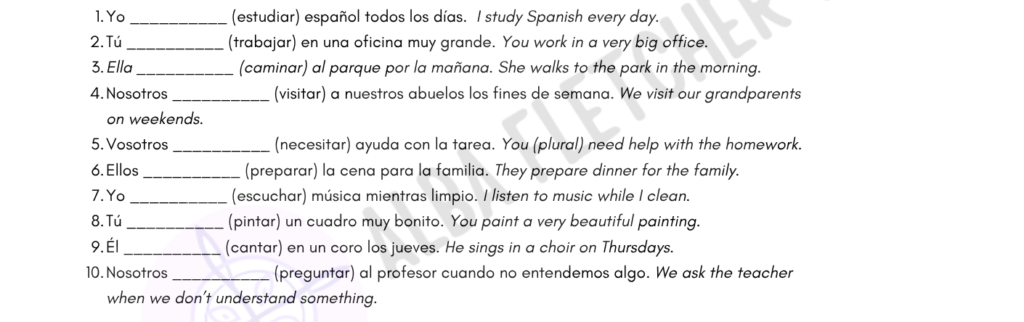
Respuestas
1: estudio 2: trabajas 3: camina 4: visitamos 5: necesitáis 6: preparan 7: escucho 8: pintas 9: canta 10: preguntamos
Si quieres más ejercicio para practicar las estructuras, haz click en el enlace abajo.
RECUERDA: intenta traducir las frases para entenderlas y aprender nuevo vocabulario y estructura.
If you want more exercises to practice the structures, click on the link below.
REMEMBER: try to translate the sentences to understand them and learn new vocabulary and structure.
How to create phrases in present in Spanish
Una vez entendida la estructura, vamos a empezar a hacer frases con el presente, pero frases útiles que puedes utilizar en conversaciones comunes.
Once the structure is understood, we are going to start making sentences in the present tense, but useful sentences that you can use in everyday conversations.
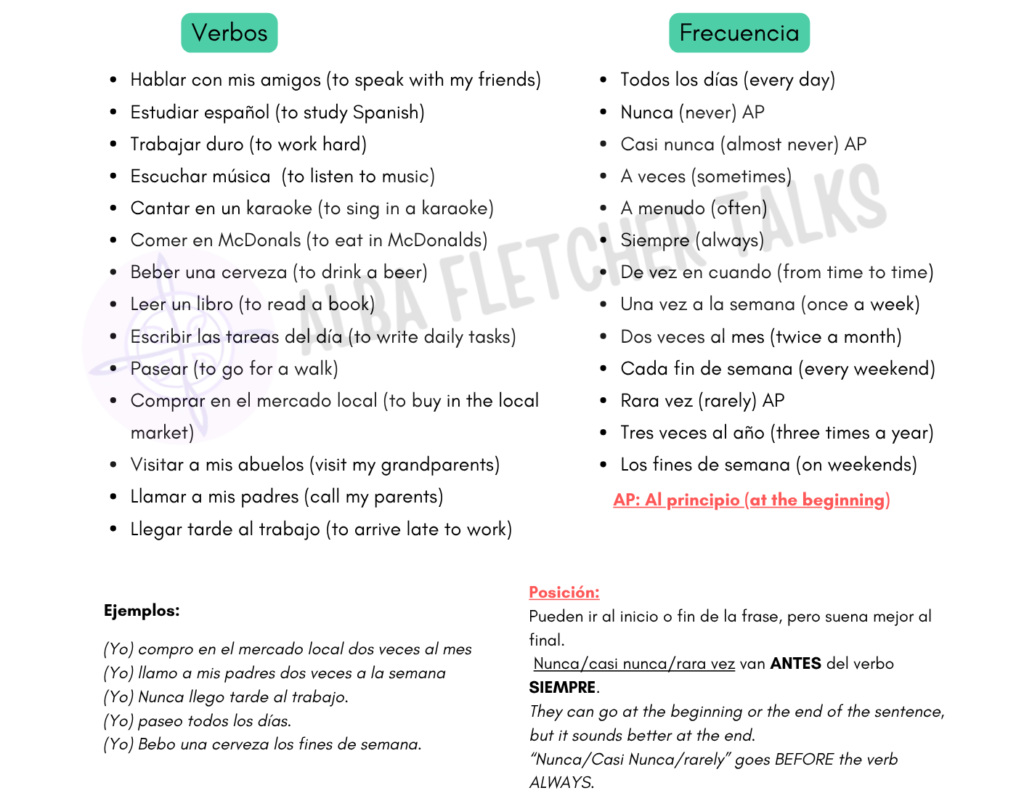
Como hacer frases en español
Ejemplos de frases en presente en español
Examples of Spanish phrases in present
¿Con qué frecuencia hablas con tus amigos?
Pues intento hablar con mis amigos cada día, pero a veces es difícil. Tenemos un grupo de whatsapp y allí hablamos todos los días.
¿Con qué frecuencia escuchas música?
Escucho música todos los días. Escucho música cuando me ducho, cuando cocino, cuando hago deporte… Escucho música todo el día.
¿Cón qué frencuencias lees?
Intento leer un libro al mes, pero a veces es complicado si tengo mucho trabajo. Entonces, pienso que más o menos leo un libro al mes.
¿Con qué frecuencia llamas a tus padres?
Llamo a mis padres dos veces a la semana. Los llamo durante la semana, de lunes a viernes, una vez. Esta llamada es corta. Y después los llamo durante el fin de semana, y esta llamada ya es más larga, como media hora.
¿Con qué frecuencia compras en el mercado local?
Compro en el mercado local cada dos o tres días. Siempre compro fruta en los mercados locales porque la calidad es muy buena.
Una vez tengas claro la primera persona (yo) puedes continuar con las siguientes personas.
Por ejemplo: Mi padre llama siempre a sus padres
¿Tú siempre vas al mercado local? ¿Cuántas veces llamas a tus padres?
¿Cón qué frecuencia paseáis? ¿Con qué frecuencia tu hermano canta en el karaoke?
Once you have the first person (I) clear, you can continue with the following ones.
For example: My father always calls his parents.
Do you always go to the local market? How many times do you call your parents? How often do you walk? How often does your brother go to the karaoke?